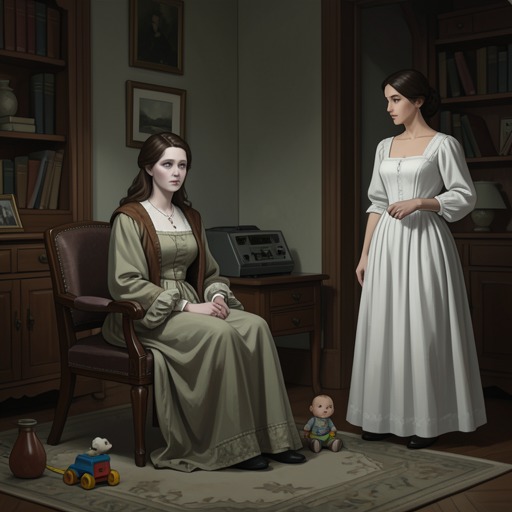
the narrator's relationship with her baby
The Yellow Wall PaperThe narrator’s relationship with her baby combines genuine affection with an inability to care for or remain near him. She calls him dear, worries about the effect the upstairs nursery might have on him, and takes comfort in his health; at the same time, she says his presence makes her nervous and relies on Mary to care for him. The separation, first described as painful, is later reinterpreted as protection for the child, revealing how the narrator’s worsening fears and her restricted circumstances reshape maternal attachment.
Affection and Separation
The narrator’s account begins with tenderness and guilt in close proximity. She describes the baby as dear and is grateful that Mary is good with him, but admits that she cannot be with him because doing so makes her nervous. This is not presented as a lack of love: the strain comes from the narrator’s own distress, which makes ordinary closeness difficult even as she remains emotionally attentive to her child.
Her sense of maternal failure is sharpened by her belief that she ought to help and comfort her husband, while she can manage little beyond dressing, entertaining, and ordering things. The baby’s care by Mary offers practical reassurance, but it also underscores the narrator’s limited part in his daily life. The text gives no account of the baby’s own response to this separation; the relationship is conveyed through the narrator’s affection, apprehension, and self-reproach.
The Nursery and the Baby’s Safety
The family’s room arrangement makes separation concrete. The narrator wanted a downstairs room opening onto the piazza, with roses at the windows, but John rejected the request, citing the lack of a second window and the absence of a nearby room for himself. He chose the large, airy nursery on the top floor as part of a plan for the narrator to rest and take in air. The room had served as a nursery, playroom, and gymnasium; its windows were barred for small children, and rings remained in the walls. Its damaged paper was torn away in patches around the bed and lower down on the opposite side.
The narrator later thinks about what the nursery might have meant for her baby. He is well and happy, and does not have to occupy the room with its horrid wallpaper. She imagines that if the family had not used it, the child would have been placed there, and calls his escape fortunate because she would not want her impressionable child living in such a room. This is a specific protective concern, but it also marks a reversal: the room John selected for her rest becomes, in her eyes, a place from which her baby has been spared.
Medical Judgment and Maternal Experience
The separation unfolds within a household where John’s medical opinion carries decisive weight. The narrator believes that he does not think she is sick; he describes her condition to others as temporary nervous depression and a slight hysterical tendency. She says he does not know how much she suffers, because he sees no reason for that suffering. Her private account of being unable to stay with her baby therefore sits beside a public and domestic framework that discounts the seriousness of her experience.
When she tells John she is not improving and wishes to leave, he insists that she is better, pointing to her apparent flesh, color, and appetite. She disputes his assessment: she says she has not gained weight and that her appetite is worse in the morning, when he is away. His confidence in his professional judgment does not resolve the gap between them. The evidence does not show that the baby is used as a treatment or that John explicitly orders their separation; rather, the narrator’s illness, the nursery arrangement, and her own distress combine to keep her apart from him.
Changing Meaning of the Separation
As the narrator’s attention fixes increasingly on the wallpaper, the baby’s absence from the nursery becomes part of her private interpretation of events. She decides that it is lucky John kept her in the room after all, because she can endure it more easily than a baby could. This thought recasts a distressing confinement as a sacrifice made for the child’s protection, though the text does not establish that this was John’s intention in choosing the room.
The narrator continues to keep her observations about the wallpaper to herself, saying there are things in it that nobody else knows. Near the end, she locks the nursery door and throws the key into the front path, intending not to let anyone in until John arrives. The baby is not present in this final action, but the locked room makes the separation physical and deliberate. Across the relationship’s arc, her affection persists while her capacity for ordinary contact and care contracts; maternal concern remains, increasingly expressed through fearful ideas about the room and the danger it might pose to her child.